
'Why pie and peas?': A Kiwi in Leeds discovers the history behind Yorkshire’s Bonfire Night menu

As a New Zealander in Leeds, the dazzle of fireworks makes sense - but a plate of pie, green mushy peas, and sticky ginger parkin was a mystery. Here is how 19th-century mill culture, damp northern soil, and Guy Fawkes himself created Yorkshire's ultimate November 5 menu
Having come from New Zealand and ventured to a few Bonfire Nights around the area since arriving in Leeds, as much as I enjoy the night skies lit up with the dazzle of fireworks and that warm feeling of being near a bonfire, there is one thing I am still trying to comprehend.
Why pie and peas, and why parkin?
Though I have been told by many that it is a tradition, where did said tradition actually come from?
To the best of my knowledge, what does a humble pastry with peas strewn over it and a thick slice of gingery goodness have to do with Bonfire Night or Guy Fawkes?
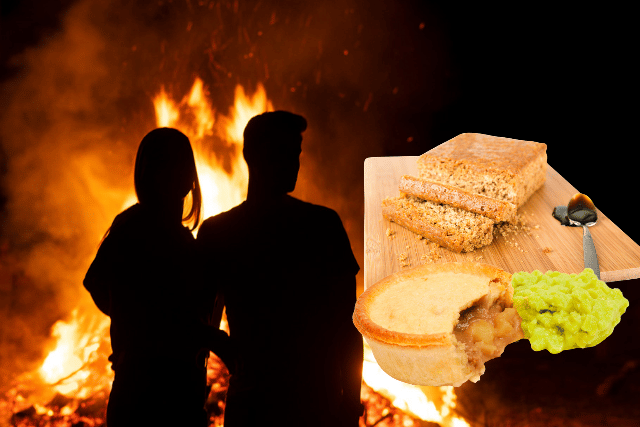

Colour me curious (pea green would be apt), but as it stands, there is good reason why that combination has become a staple of Bonfire events around the city - and it started long before Guy Fawkes ever set foot near the Houses of Parliament.
While standing in a frosty field in and around Leeds with a steaming bowl of mushy peas might seem like a quirky modern preference, every element of this Bonfire Night feast is rooted in centuries of northern agricultural history, Industrial Revolution survival, and a dash of local pride.
Here is how a damp northern climate and 19th-century mill culture gave us Yorkshire’s ultimate November 5th menu - and perhaps a good reason why I should pipe down and enjoy my pie (and peas... and parkin),
Northern grain and treacle: how parkin was born
Long before gunpowder entered the equation, early November marked a crucial turning point in the northern agricultural calendar. In rural Yorkshire, wheat struggled to thrive in the cold, damp soil, making oats the dominant grain crop across the West Riding.
When the autumn oat harvest was brought in, farmworkers combined the grain with lard and ginger to create a dense, highly nutritious cake that could survive the winter months.
Enter the Industrial Revolution.
In the 18th and 19th centuries, cheap black treacle (molasses) began arriving in huge quantities via Yorkshire’s expanding canal network and ports like Hull. When mill workers combined oats, butter, ginger, and black treacle, Yorkshire parkin was born.
Because parkin actually improves as it sits in an airtight tin - with the treacle slowly softening the coarse oats into a sticky, rich sponge over several days - baking a batch ahead of November 5 became a ritual.
Throughout 19th-century West Yorkshire mill towns, the fifth of November was widely known not as Bonfire Night, but as "Parkin Day," where factory workers shared thick slices around community blazes for a much-needed energy boost in the freezing autumn air.
Pie and peas: fuelling the community bonfire
If parkin provided the sweet high-calorie energy, pie and peas were the heavy-duty savoury engine designed to feed hundreds of cold spectators on a budget.
The tradition of serving marrowfat peas comes down to practical winter storage; they were harvested in late summer and left to dry out naturally so they would keep indefinitely through the winter.
Preparing them required a bit of foresight: the dried peas were soaked overnight in water with a pinch of bicarbonate of soda before being slowly simmered down into thick, creamy, mushy peas.
In industrial hubs like Leeds, Bradford, and Wakefield, Bonfire Night celebrations were traditionally hosted by working men's clubs, local pubs, and neighbourhood committees.
Cooking up massive vats of marrowfat peas alongside trays of hot individual meat pies was simply the most cost-effective, efficient way to feed a cold crowd standing outdoors.
A lash of sharp mint sauce or Henderson's Relish added just enough kick to cut through the rich pastry and gravy.
Guy Fawkes the Yorkshireman
Want an added bit of Bonfire bonus trivia ahead of your next pub quiz meet?
Guy Fawkes was born right here in Yorkshire - born in Stonegate, York, in 1570 and educated at St Peter's School in the city.
When Parliament passed the Observance of 5th November Act in 1606, declaring the day a national holiday of thanksgiving following the failed Gunpowder Plot, Yorkshire communities embraced the occasion with fierce enthusiasm.
Over the centuries, as religious protest faded into local folk tradition, the community gathering remained - and so did the regional food served around the flames.
So, while a pie covered in bright green mushy peas followed by a slice of sticky ginger cake might look like an unusual combination to an outsider, it is actually a 200-year-old piece of edible Yorkshire history.