
‘Lucky to hit second gear on the M62’: Leeds drivers clash over whether 70mph motorway limit should be raised

First introduced in 1965, the UK's 70mph national motorway speed limit has remained unchanged for nearly six decades - we asked Yorkshire Evening Post readers if it’s time for a change, and here is what you had to say
The UK's 70mph motorway limit was introduced as a temporary trial back in December 1965, before being made permanent in 1967.
At the time, the average family hatchback struggled to reach 80mph, let alone sustain it safely.
Six decades later, today’s vehicles feature ABS, lane-assist, cruise control, and significantly shorter stopping distances.
Yet, the national speed limit remains untouched.
When we asked Yorkshire Evening Post readers on our Facebook whether the limit should finally be raised to 80mph or higher, hundreds weighed in - ranging from those demanding European-style 80mph limits to drivers pointing out that getting anywhere near 70mph on the M62 is a distant fantasy.
Here are the key takeaways from the debate.
"Cars have changed, but drivers haven't" - The Case for Raising the Limit

A large group of readers argued that vehicle safety technology has far outstripped the law, making 70mph an outdated relic of the 1960s.
Carl Sigsworth was among those calling for a change, arguing that modern cars are much safer, faster, and equipped with vastly superior braking systems compared to when the limit was originally set.
John C Ure II agreed, adding that safety systems and vehicle engineering have advanced tenfold since the 1970s.
Other readers looked overseas for inspiration. Jonathan Handford pointed out that the UK has one of the slowest motorway speed limits in Europe, where a limit of 80mph (130kph) is standard across countries like France, Belgium, Austria, and Switzerland.
Martin Allan took it even further, suggesting that modern vehicle standards could easily accommodate a 100mph limit.
"Lucky to hit 2nd gear" - The West Yorkshire Traffic Reality
For many commuting across Leeds and the wider region daily, discussing an 80mph limit felt entirely academic given the harsh reality of local traffic and permanent roadworks on the M62 and M1.
MG James summed up the frustration of many, joking that drivers are "lucky to do 2nd gear on the M62 half of the time."
Chris Gaunt shared a similar sentiment, admitting that on his regular M62 commutes, he considers speeds between 40mph and 60mph to be purely aspirational.
Jason Higgins questioned what motorways supporters of a speed increase were actually driving on, noting he hasn't managed to get above 50mph on the M62 for the past year.
Meanwhile, Pawel Strozynski highlighted the endless roadworks covering nearly 40% of the UK network, and Dean Clarkson added that most drivers are lucky to reach 45mph during peak hours.
Middle-Lane Hoggers & Driving Standards - The "Keep It at 70" Camp
Opponents of a speed limit increase argued that poor lane discipline, aggressive tailgating, and middle-lane hoggers mean raising the speed limit would lead to far more serious collisions.
Mark Reilly argued that authorities ought to enforce proper lane discipline before even considering speed increases.
Wendy Robb Asquith strongly opposed any increase, comparing motorway driving to "playing dodgems" and suggesting the limit should actually be lowered to 60mph to save lives.
John June described the chaotic reality of current driving standards, where a huge proportion of road users are either pootling along at 50mph in the middle lane or flying at extreme speeds in the outside lane, with nobody using the lanes correctly.
Spencer Baker echoed the frustration, calling on police to crack down on middle-lane hoggers, while Ian Worth insisted that limits should stay strictly as they are until overall driving standards drastically improve.
Weather-Variable Limits & Minimum Speed Rules
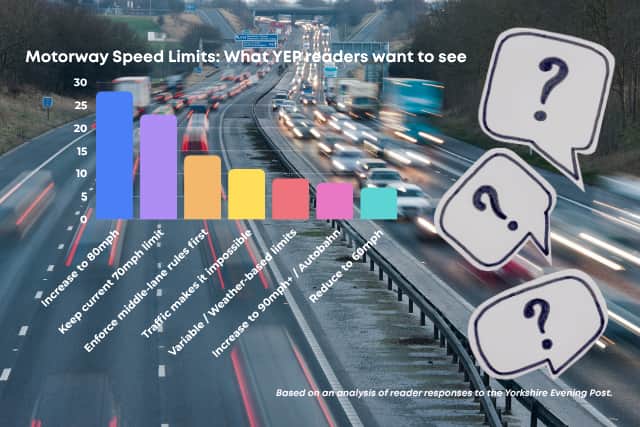
Several readers suggested middle-ground solutions, proposing flexible rules depending on weather conditions, lane usage, or enforcing minimum speed limits to prevent dawdling.
James Bovington suggested an 80mph limit specifically for good weather conditions.
Taking a different angle, Glenn Simon Knowles advocated for a minimum speed limit of 70mph for cars on motorways, arguing that slower drivers doing 50mph should stick to scenic routes to keep long-distance traffic moving smoothly.
Graham Lovis supported variable limits tailored to live traffic, calling it ridiculous that the same speed applies during crowded downpours as it does on clear, empty roads late at night.
Ben Brewitt proposed a lane-by-lane breakdown with Lane 1 at 60mph, Lane 2 at 70mph, and Lane 3 at 80mph, alongside dynamic weather reductions when rain hits.