
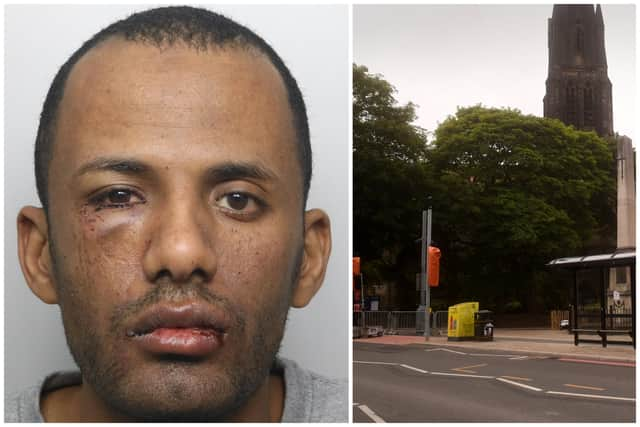
Murderous broken-bottle attacker who tried to kill woman at Leeds student hotspot given 25-year sentence
He randomly attacked stranger as she passed popular pub
A mentally-ill thug who tried to murder a passing woman with a broken bottle has been handed a 25-year sentence.
The victim had enjoyed dinner at a local restaurant and was walking along the busy Headingley street when Ibrahim Albashir suddenly appeared from behind and without word, lunged at her with the lethal weapon.
Brave members of the public were forced to intervene and save her life after hearing a “blood-curdling scream”.
One witness said he used so much force with each thrust of the bottle that he was certain Albashir was trying to kill her. It was reported he attempted to stab her more than 30 times.
Albashir, who has no previous convictions, eventually admitted a charge of attempted murder for the sickening assault on Otley Road in March 2024.
The 34-year-old schizophrenic appeared at Leeds Crown Court this afternoon when he was given a hybrid hospital order to ensure he receives ongoing treatment.
He will be detained in a secure hospital unit and once he is well enough, he will be transported to prison to serve the remainder of the sentence.
Judge Robin Mairs told Albashir: “It was St Patrick’s Night so the area would have been relatively busy.

“You approached and almost immediately began to stab her with a broken bottle to the neck and head area.
“She thought it was a drink because it felt wet. She then realised it was painful and she was bleeding.
“The attack was repeated and determined.
“It would appear from the CCTV that you were laying in wait.
“This was, in my view, not random.”
He said that despite his mental illness, he was convinced that Albashir “knew the nature and quality” of his actions at the time of the attack.
He also said that he rejected Albashir’s claim he could not remember the incident and was “simply not willing to be candid” about his motivation.
Judge Mairs also felt there was a sexual element to his offending, following previous reports of Albashir making sexual advances towards women.
The victim, who is in her 30s, had been walking on the opposite side of the road to the Original Oak pub at around 9pm on March 17, 2024.
Male witnesses stood outside the pub heard a scream and turned to see the woman being held by Albashir in a chokehold with one hand, while he thrusted a broken bottle neck repeatedly towards her head, neck and chest.
The men ran towards him and shouted at him to stop but he persisted, prosecutor Brian Russell told the court.
One member of the public then aimed a punch at Albashir, knocking him over the wall. He got up but a second punch rendered him unconscious.
He was detained until police arrived while others tended to the heavily-bleeding victim who had wounds to her head, neck and chest.
Albashir, who is from Sudan and was homeless at the time, later pleaded guilty to attempted murder on what would have been the first day of his trial.
Questions were initially raised about his fitness to plea, but an expert medical witness found that Albashir was capable of forming the intent to murder at the time.
Albashir has been admitted to a secure unit in Lancashire, having previously being held on remand at HMP Lincoln.
Dr Lucy Bacon, a consultant forensic psychiatrist, gave evidence during today’s sentencing hearing and confirmed that Albashir suffered from catatonic schizophrenia, with symptoms including persecutory beliefs.
She said that during a serious episode, he suffers incoherent speech which can make him appear “zoned out” or even intoxicated.
It was heard that just two days before the incident, he had been seen running around Leeds with his pants around his ankles. He was described as being in a “trance-like state”, but it was thought it was caused by drug use.
Dr Bacon said his condition was not related to alcohol or drug use.
She said he had previously been hospitalised in France due to an “episode”.
Dr Bacon also added that he has still not provided any explanation as to why he tried to murder the woman in Headingley.
Mitigating, Katherine Robinson said that despite a lack of explanation, there was remorse.