
Leeds Discovery Centre: How incredible Ice Age predators are being conserved in city

“It’s extraordinary to imagine that these remarkable animals once lived in the UK and walked in the very same places where we live and work today”
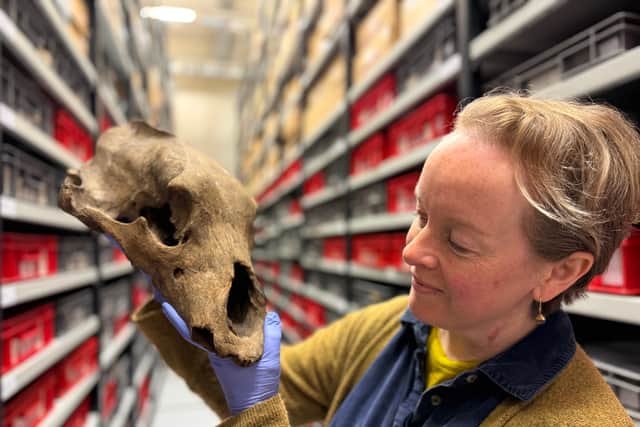
An ancient bear which roamed the UK thousands of years ago is among the fearsome prehistoric predators whose remains are being conserved by experts in Leeds.
Excavated from the depth of an Irish cave in the 1860s, the impressive skull once belonged to a huge type of extinct brown bear and today resides at Leeds Discovery Centre alongside other astonishing megafauna from the Pleistocene era.
More commonly known as the Ice Age, the time period lasted from around 2.58 million to 11,700 years ago, and saw large mammals including bears, wolves and hyena live around the UK before many species were hunted into extinction by early humans.
Earlier this week, curators carried out condition checks and cataloguing of some of the city’s huge collection, the majority of which was found by Victorian naturalists in peat bogs and cave systems across the Britain and Ireland.
Alongside the bear skull, the collection includes the tooth of a wolf found in Torquay’s famous Kents Cavern, once home to a number of prehistoric mammal species as well as Neanderthal humans.

Also preserved in Leeds are the teeth and jawbone of an ancient cave hyena, discovered in Kirkdale Cave in North Yorkshire. Cave hyenas were once apex predators in countries all over Europe, hunting and feeding on other large mammals including deer and wild horses.
An even older example of a one-time UK predator which also forms part of the collection is the gigantic tooth of a megalodon, the largest shark which ever lived and which swam in waters around the UK around 23 million to 3.58 million years ago.
Megalodon is believed to have grown to up to 80 feet in length. As well as predators, curators have also been cataloguing the remain of other ancient animals including the skull of a giant Irish elk and a mammoth tusk and tooth.
YEP RETRO NEWSLETTER: Sign up for our free monthly email digest of Leeds nostalgia
Clare Brown, Leeds Museums and Galleries’ curator of natural sciences, said: “It’s extraordinary to imagine that these remarkable animals once lived in the UK and walked in the very same places where we live and work today.
“Their remains give us a unique insight into an age ruled by what must have been fascinating, beautiful and fearsome beasts which existed alongside, and were ultimately hunted into extinction by, some of the earliest humans.
“Studying the remains in our collection can help us understand hundreds of thousands of years of evolution, discovering more about these animals’ origins and the impact which human behaviour and rapidly changing climates can have on different species.”
The collection of ancient species can be seen at Leeds Discovery Centre as part of regular store tours and are part of more than a million objects stored at the centre and available for visitors to view.
Councillor Salma Arif, Leeds City Council’s executive member for economy, said: “Our incredible collection gives visitors the chance to step back through thousands of years of history and discover a completely different world from the one we know today.
“Thanks to the diligence and dedication of our site teams, we’re fortunately able to ensure these precious relics are preserved so they can capture the imaginations of our visitors and inspire future generations.”
Leeds Discovery Centre is open to the public for pre-booked tours and is a Give What You Can museum, where visitors are invited to donate to support the museum if they are able.
Donations can be made when booking a tour online, and with cash and coins in a donation box in reception.
* For more details please visit: Visit Leeds Discovery Centre | Leeds Museums and Galleries | Days out and exhibitions