
The story of the first ever letter to Santa written in Leeds

Her name was Jane and she was six.
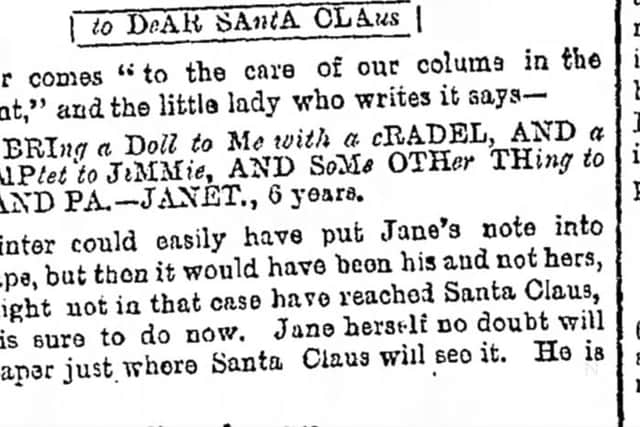
And she wrote what was the first believed letter to Santa back in 1883.
It was published in The Leeds Mercury on Saturday, December 22, of that year where the youngster requested “a doll with a cradle, a trumpet to Jimmie, and some other thing to Ma and Pa.”

It’s a timeless tradition that lives on today, and new research commissioned by genealogy firm Ancestry shows that as many as 75 per cent of children of the parents surveyed still send letters to Santa. However, it seems the methods used are changing. Whilst the majority of these children continue to hand-write their letters (83 per cent), millennial parents are opting for change.
Parents aged 25 to 34 years are starting to adapt the long-held tradition, introducing more tech-savvy ways for their children to connect with Santa.
The study found that 22 per cent of millennial parents surveyed with children who write letters to Santa encourage their children to type their letter before printing and posting it, whilst another 22 per cent opt for recording short video messages. Additionally, 21 per cent favour typing and submitting letters digitally, and 15 per cent rely on recording a voice note.
When it comes to the contents of letters to Santa, whilst wish-lists remain in 77 per cent of letters to Santa today, it’s likely the requests will be a little different from times gone by.
Ancestry research shows letters through the ages, from poignant, selfless requests such as “Please fill my brother’s stocking if you don’t have much, leave mine” (Hampshire Telegraph and Naval Chronicle, 1898) and “Don’t forget the evacuees and poor children Santa” (The Ormskirk Advertiser, 1940), through to requests for increasingly modern toys and gifts such as “a train set and bike” (Evening News & Star, 1950) and a “Rockin’ Rhymes CD” (The Sunday Telegraph, 1993).
Laura House, Ancestry family history expert and genealogist,, said: “Letters to Santa’ appear in UK newspapers as early as 1883, giving us a rare glimpse into the dreams and values of children from the Victorian era to the present day. Children’s toys and gadgets change over the centuries and their requests become more humble during major events like the Second World War; but with a toy trumpet making the wish list in 1883 and a CD in 1993, themes like music hold strong through the generations.”
She added: “Three quarters of parents agree that writing letters to Santa will still be a tradition in 20 years’ time, so this Christmas we encourage people to search their family’s keepsakes for letters to Santa and to preserve this year’s festive wishes on Ancestry for future generations.”