
Tiny crumb of ancient Egyptian bread entombed for 3,000 years with mummified remains discovered in Leeds

A tiny breadcrumb entombed thousands of years ago alongside an ancient Egyptian’s mummified remains has been discovered in Leeds.
The tiny morsel, which is believed to be up to 3,000 years old, was originally unearthed in Thebes, the site of some of the most famous and spectacular archaeological finds of the last century.
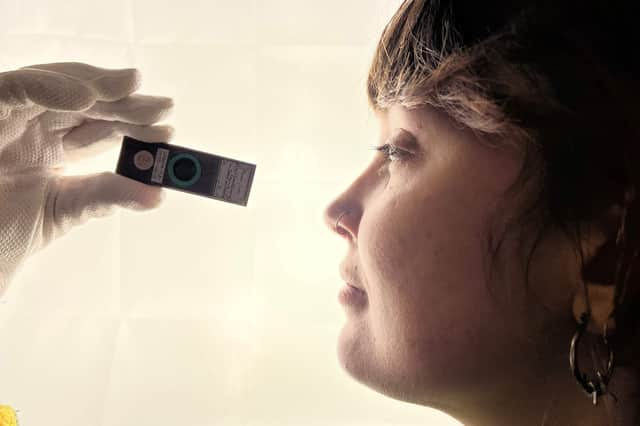

It was later preserved by an unknown Victorian microscopist and stored as part of collection of slides - which made their way to Leeds and had not been catalogued until now.
The astonishing collection of thousands of microscopic treasures is being painstakingly reviewed as part of a volunteer project at the Leeds Discovery Centre.
And remarkably, the piece of bread is not the only astonishing miniature marvel found during the work.
Another slide contains a miniscule speck of dust from the infamous Krakatoa volcanic eruption of 1883, one of the most destructive events of its kind in recorded history, which was so loud it was heard more than 1,900 miles away.
It landed on the deck of a ship called the Arabella, which was sailing 1,000 miles to the west of the Indonesian island.
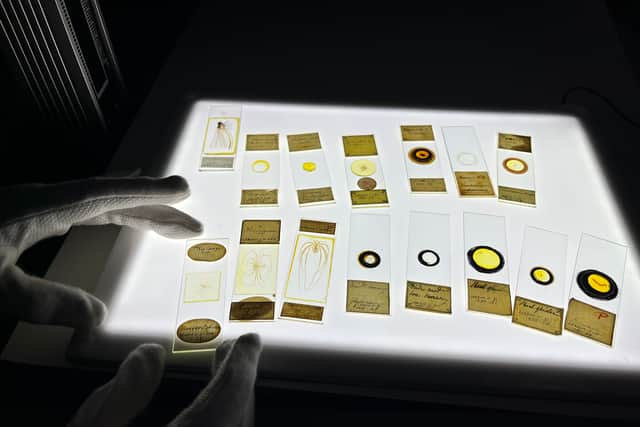
Specimens of microscopic sea creatures found during one of history’s most renowned and influential scientific voyages are also among the amazing array of slides.
The HMS Challenger left Sheerness on the north Kent coast in 1872, embarking on an unprecedented mission to circumnavigate the globe and comprehensively explore the deep seas for the first time.
Returning three and a half years and 68,890 nautical miles later, the crew had gathered marine plants and animals, sea-floor deposits and rocks from the depths which completely changed scientific understanding of the oceans.
Examples found in the Leeds collection today include small disc-like fossils called orbitolites, which were gathered 18 fathoms down off the coast of Fiji.
Also part of the collection is a fully miniaturised late Victorian copy of The Times, with all 12,500 words shrunk down to a size where they can only be read with the aid of extreme magnification.
The slides are now in the process of being carefully catalogued by volunteer Stephen Crabtree, who initially began working with the museum to study fossilised plants.
His studies soon revealed a hoard of historical treasures, with slides created by noted Victorian microscopists including James Lomax, Walter Hemingway and James Spencer.
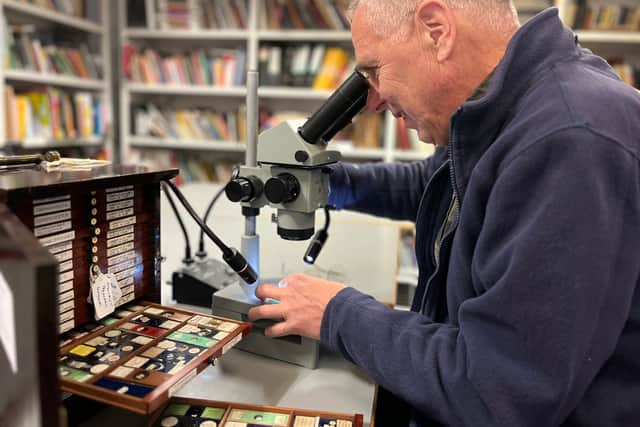
Clare Brown, the curator of natural sciences at Leeds Museums and Galleries, has supervised the slides project.
She said: “What began as a fairly routine cataloguing exercise has slowly uncovered a remarkable archive that includes of some of the most important moments in scientific history.
“Discovering a morsel of ancient Egyptian bread was particularly surprising, and the fact we can connect the Leeds collection to bread baked thousands of years ago on a different continent is fascinating.
“We don’t know exactly how or where many of these slides were collected, but we do know that each one of them was meticulously preserved for study and posterity by a diligent microscopist more than a century ago.
“That in itself is evidence of how important they thought these specimens were and how much they wanted future generations to see and be inspired by them.
“We’re extremely grateful to them, and to Stephen for following in their footsteps and rediscovering their work all these years later.”
Once the collection has been documented and photographed, the aim will be to add it to a national database so it can be viewed and accessed by academics, experts and the public.