
Leeds woman with rare blood disorder says she lives in fear of dying with constant worries about organ failure

A woman with a rare blood disorder said she lives in fear of dying, with constant worries about organ failure or having a stroke.
Solome Mealin, from Leeds, suffers from sickle cell disease - a debilitating condition that can cause pain, infections, and reduce life expectancy.


Diagnosed at just four-years-old, she said that the disorder has affected every aspect of her life and has left her feeling like she has to work harder than many of her peers.
But thanks to a £9,000,000 government investment in new technology for the NHS, she’s set to benefit from access to specialist treatment.
Speaking on World Sickle Awareness Day (June 19), Solome said: “The disease has affected me in every way: mentally, physically, socially, financially.
“The constant pain is the main destroyer. Everything I do, I have to work harder and always feel behind my peers. Many dreams have been shattered - and yet I had so many.”
In England, there are around 17,000 people living with sickle cell disease, an inherited blood disorder, with 250 new cases a year. It is generally more common in people of Black African, Caribbean, Middle Eastern and South Asian heritage.
Solome continued: “I worry constantly about organ failure or having a stroke. I’m scared of dying, especially because I never want to leave my triplets when they’re still so young. My mum died before I had the chance to know her. She never got to experience motherhood - in that respect, I feel lucky.”
Thankfully, as a result of the recent investment, specialist services will expand across England, enabling faster and more accessible treatment for patients - including the use of new automated blood exchange devices where they are most needed.
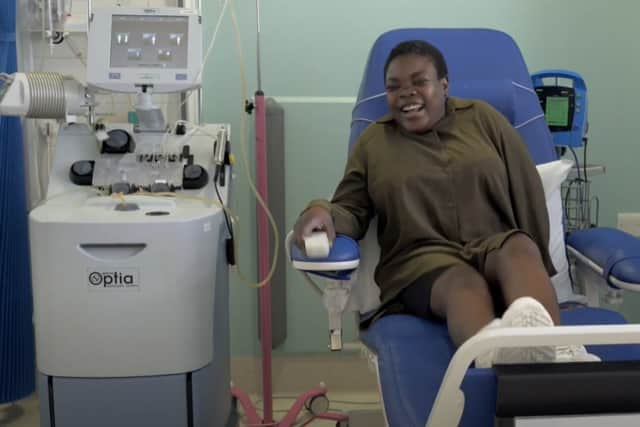
“When I came to England in 2004, I understood the severity of my illness and received far better care than I had in Uganda,” said Solome. “Access to better treatments has helped me become someone I never thought I could be. I’ve always been lonely and depressed because of the illness.
“Now I’m a wife, a proud mummy to triplets, a good friend to many, a student, and someone who catches moments of happiness. I’ll never stop thanking the NHS, my haematology team, blood donors, and everyone who makes safe blood available for me - and my family and friends who've stood by my side.”
Richard Stubbs, CEO of Health Innovation Yorkshire & Humber and Chair of the Health Innovation Network, said: “Sickle cell disease disproportionately impacts people from West African and Afro-Caribbean communities, many of whom live in the most socio-economically deprived areas.
“These patients are at higher risk of hospital re-admissions and of dying in a hospital, making timely and accessible care even more vital. We have led this programme on behalf of the Health Innovation Network. It is a powerful example of how cross-sector collaboration can accelerate the uptake of life-changing innovations and reduce health inequalities.
“This new funding announced today will enable the technology to be used on a longer-term basis, supporting frontline staff and ensuring sickle cell patients receive more regular care closer to where they live, as well as continuing our focus on tackling healthcare inequalities.
“Sickle cell disease can be viewed as a health inequality, often due to geographical variation in access to care. This funding will help to ensure that all sickle cell patients receive the care and treatment that they require.
“We’re proud to work with our NHS partners to support the spread of proven medical technologies, whether devices, diagnostics, or digital products, to improve care outcomes and patient experience.”
The funding will ensure that Spectra Optia devices, which perform automated cell exchanges, are more widely available to patients with this condition to help more people like Solome. The treatment process involves removing a patient’s sickled red blood cells and replaces them with healthy donor cells.